What a 10 Seater Actually Solves
Ten is the number most families arrive at without ever planning for it. Six of you were always going. Then the grandparents said yes, then a cousin joined at the last minute, and suddenly two cars mean two sets of directions, two petrol stops, two arguments about where to have lunch, and one child asleep in the wrong vehicle.
A 10 seater tempo traveller solves that specific mess, and it does it for less money than most people assume. You get one driver, one bill, one WhatsApp location pin, and enough seats that nobody is riding with a bag on their lap. It’s the smallest vehicle in the fleet where the whole group stays a single unit for the entire trip.
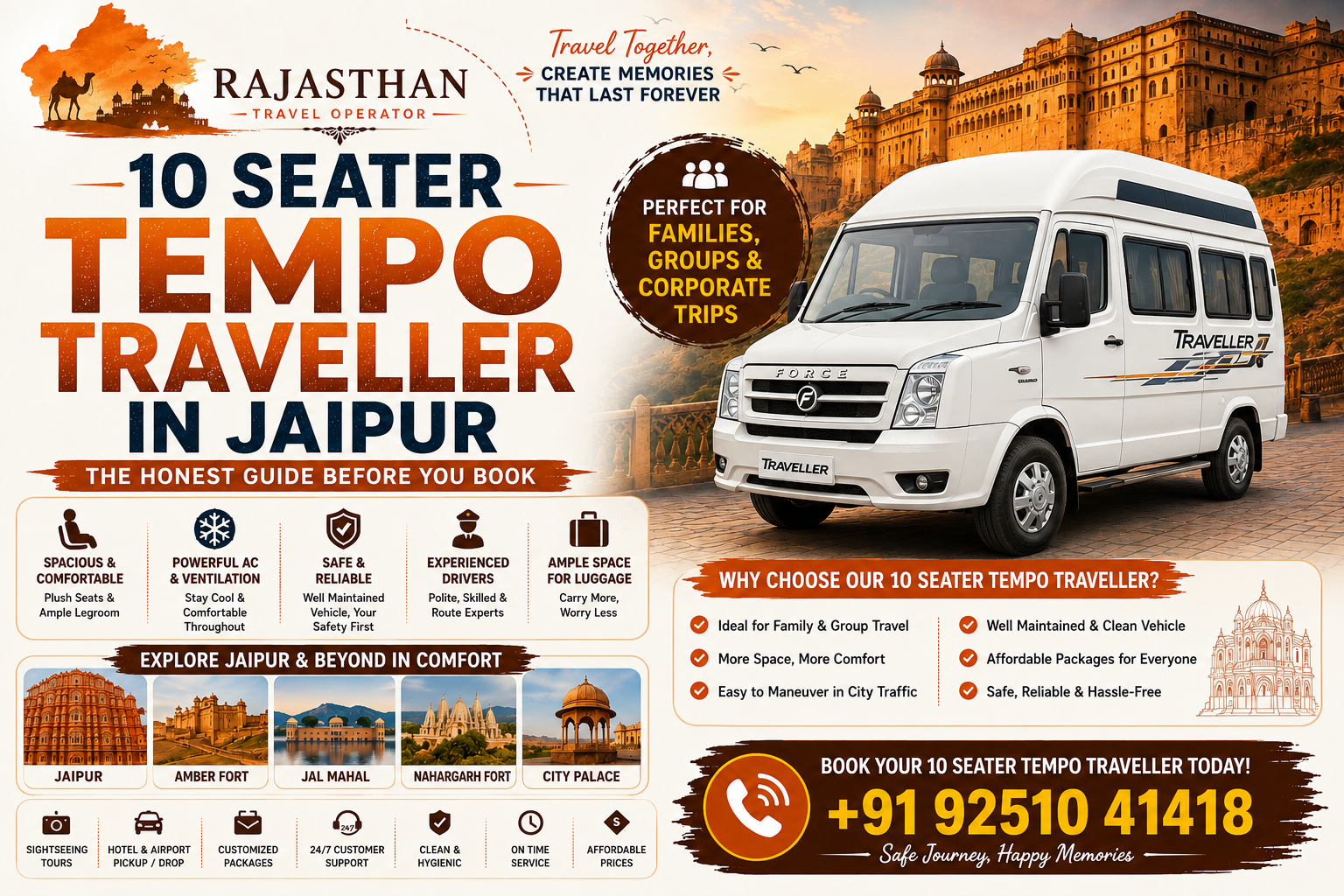
Here’s the part operators rarely lead with, though: a 10 seater is usually not a smaller vehicle. In most Jaipur fleets it is the same Force Traveller body as the 12 seater, running two seats fewer. Same length, same footprint, same road manners — only the interior has been given away to legroom and boot space instead of headcount. That is the whole product. You’re not paying to shrink the van. You’re paying to un-crowd it.
Which also explains the pricing that surprises people: a 10 seater often quotes close to a 12 seater tempo traveller, not far below it. The vehicle costs the same to run. You’re buying the empty space.
The Seat Math at Ten
Ten seats plus the driver, and unlike the bigger bodies, ten here usually behaves like an honest ten. Rows have breathing room. The last row isn’t a punishment posting. Nobody has to slide sideways past three pairs of knees to reach a window.
Luggage is where this size quietly wins. The tempo traveller keeps its ladder frame, which means it keeps its roof carrier — and that one fitting changes the arithmetic completely. Big suitcases go up top under a tarp and rope, the boot behind the last row stays free for day bags and water crates, and the aisle stays walkable. Ten adults with ten full multi-day bags is a real, workable configuration here. It is not workable in a monocoque vehicle, which is the trade the whole Urbania tempo traveller platform asks you to accept in exchange for its ride quality.
So count like this. Ten adults with luggage: comfortable. Ten adults with luggage plus a pram, a wheelchair and wedding shopping: still fine, tell the operator in advance so the carrier is fitted and roped before pickup. Eleven or twelve confirmed: don’t squeeze, move up a size and stop thinking about it.
And if the list shrinks instead of grows — seven or eight people, no more — the 9 seater tempo traveller is genuinely cheaper per day and does the same job. There’s no prize for booking bigger than you need.
Where the 10 Seater Sits in the Fleet
Somewhere in the middle, and comfortably so. It’s the value pick of the mid-size bracket: the ride and the mechanicals of a standard tempo traveller, with the seat pitch of something much more expensive.
Trim is where it splits. A basic 10 seater comes with 2×2 pushback seats, a dashboard blower and not much else. A better one comes with proper recliners, roof-mounted AC, curtains, LED strips and a music system that works — usually sold as a luxury tempo traveller and priced accordingly. A third variety fits captain chairs instead of rows, which the market calls a Maharaja seat tempo traveller — fewer, wider chairs with armrests on both sides and space to actually cross your legs.
Keep one thing straight, because it costs people money every season: seating and body are two separate decisions. Maharaja seats can sit inside an ordinary body, and an Urbania can arrive with plain seats. Comfort comes from the combination, so ask about both, by name, in the same message. The full ladder of sizes and trims lives on the tempo traveller on rent page if you want to see where your group actually lands.
The other axis is the premium jump. If ride quality matters more than money — long highway hours, elderly passengers, a high step-in that someone will struggle with — the 12 seater Urbania rides better than any standard body will, and the 9 seater Urbania with Maharaja seats is the most comfortable thing in this whole category for a smaller group. Both cost noticeably more per day, and neither takes a roof carrier. That’s the deal.
Who Should Book It — and Who Shouldn’t
Book it for a family of eight to ten doing Rajasthan properly. Jaipur–Jodhpur–Udaipur, Jaipur–Jaisalmer, the Golden Triangle over three or four days — routes where the bags are real and the hours are long.
Book it for a temple circuit. Khatu Shyam Ji, Salasar, Nathdwara, Ajmer Sharif, Pushkar. Mixed ages, early starts, prasad and blankets and a lot of stopping.
Book it when the group has done a trip in two cars before and came back annoyed about it.
Book it for corporate and event duty where the requirement is ten people moved reliably, not ten people impressed. Guest pickups, site visits, staff shuttles — the 10 seater is the sensible line item.
Think twice if the headcount is soft. “Around ten, maybe eleven or twelve” is not ten. Book the size your worst-case list needs, because a seat added on the morning of departure costs far more than a seat booked in advance.
Think twice if the trip is one short city circuit for ten people who’d be equally happy in two cabs. Half-day inside Jaipur, no luggage, no elderly passengers — the van is the more expensive way to do that.
Skip it entirely if the real problem is capacity. Wedding movement, a school group, a full office outing at fourteen or sixteen heads — that’s a job for the 16 seater tempo traveller, and one full cabin will always beat two half-empty ones on both cost and coordination.
The Routes Where It Earns Its Keep
Jaipur–Udaipur and Jaipur–Jodhpur. Six to seven hours of good highway with a full family aboard. Enough time in the seat that legroom stops being a spec sheet number and starts being the reason nobody’s complaining at the second toll plaza.
The Golden Triangle. Jaipur–Agra–Delhi across three days, hotel to monument to hotel, bags loaded and unloaded twice a day. The roof carrier does more work on this itinerary than any feature inside the cabin.
Ranthambore, Pushkar, Ajmer and Bharatpur weekends. Two to four hours each way, mixed ages, one overnight. The 10 seater is almost perfectly specified for this and it’s the most common booking of the size.
Mount Abu and the Aravalli runs. Longer, hillier, more ghat sections. Ask for the newer vehicle in the fleet for this one — engine condition matters more on gradients than anywhere else in Rajasthan.
Khatu Shyam Ji and Salasar darshan. Straightforward roads, restful for a family group. Just confirm parking and approach for your exact dates, because mela weeks rewrite the plan for every vehicle on the road.
Before You Book — Five Things in Writing
Ask which body the 10 seats are sitting in. Some Jaipur fleets fit ten seats into a full-length 12-seater body — that’s the good version, the one with real legroom and a deep boot. Others quote a genuinely short-wheelbase van as a 10 seater, and it is a tighter vehicle for the same headcount. Ask the model and get the answer in text, not on a call.
Confirm the AC type and the RC year. Roof-mounted AC or a dashboard blower is the single biggest comfort difference in a Rajasthan summer, and it’s the thing photos never show. Ask for the registration year as a plain number while you’re at it — how quickly that comes back tells you plenty about the operator.
Confirm the roof carrier, out loud. It’s standard on this body, but “standard” and “fitted on the vehicle coming to your gate” are different sentences. Say how many large suitcases you’re carrying and let them confirm the plan before departure, not in the driveway at 5 a.m.
Kilometre cap and the beyond-cap rate. Usually 250–300 km a day. Multi-city Rajasthan itineraries cross that routinely. Get the per-km figure in the same message as the quote, not after the trip.
One all-inclusive number on WhatsApp. Tolls, state permits, parking, driver food and stay, night charges. Two quotes that look far apart on paper are usually the same total, dressed differently.
Frequently Asked Questions
How many people actually fit in a 10 seater tempo traveller? Ten passengers plus the driver, and it’s an honest ten — with the roof carrier fitted, ten adults with full multi-day luggage is a normal, comfortable configuration rather than a stretch.
Is a 10 seater cheaper than a 12 seater? A little, not dramatically. It’s usually the same vehicle running two seats fewer, so the running cost barely changes. What you’re buying is legroom and boot space, not a discount.
Does it have a roof carrier? Yes — that’s one of its real advantages over the Urbania platform, which can’t take one at all. Confirm it’s fitted for your specific booking anyway.
Tempo traveller or Urbania for ten people? Tempo traveller if luggage and budget matter. Urbania if the priority is ride quality on long highway hours and you can live with everything travelling inside the cabin.
How early should I book? Four to five days in normal season. Seven to ten days around wedding muhurats, Diwali, the Pushkar fair window and long weekends — the well-maintained vehicles get committed first, and the ones left over are the reason people write bad reviews.
Final Word
The 10 seater is the least glamorous booking in the fleet and one of the smartest. It doesn’t win on comfort — the Urbanias do that. It doesn’t win on capacity — the bigger bodies do that. What it wins on is fit: for a family or a team of eight to ten with real bags and a real itinerary, nothing else in the range is this correctly sized.
So count your people with their luggage physically in front of you, be honest about whether the list might grow, ask which body the ten seats are bolted into, and get one all-inclusive figure in writing before you commit. Do that, and you can book the 10 seater tempo traveller in Jaipur knowing exactly what’s pulling up at your gate — which is, in the end, the only part of this that ever goes wrong.