What a 9 Seater Actually Solves
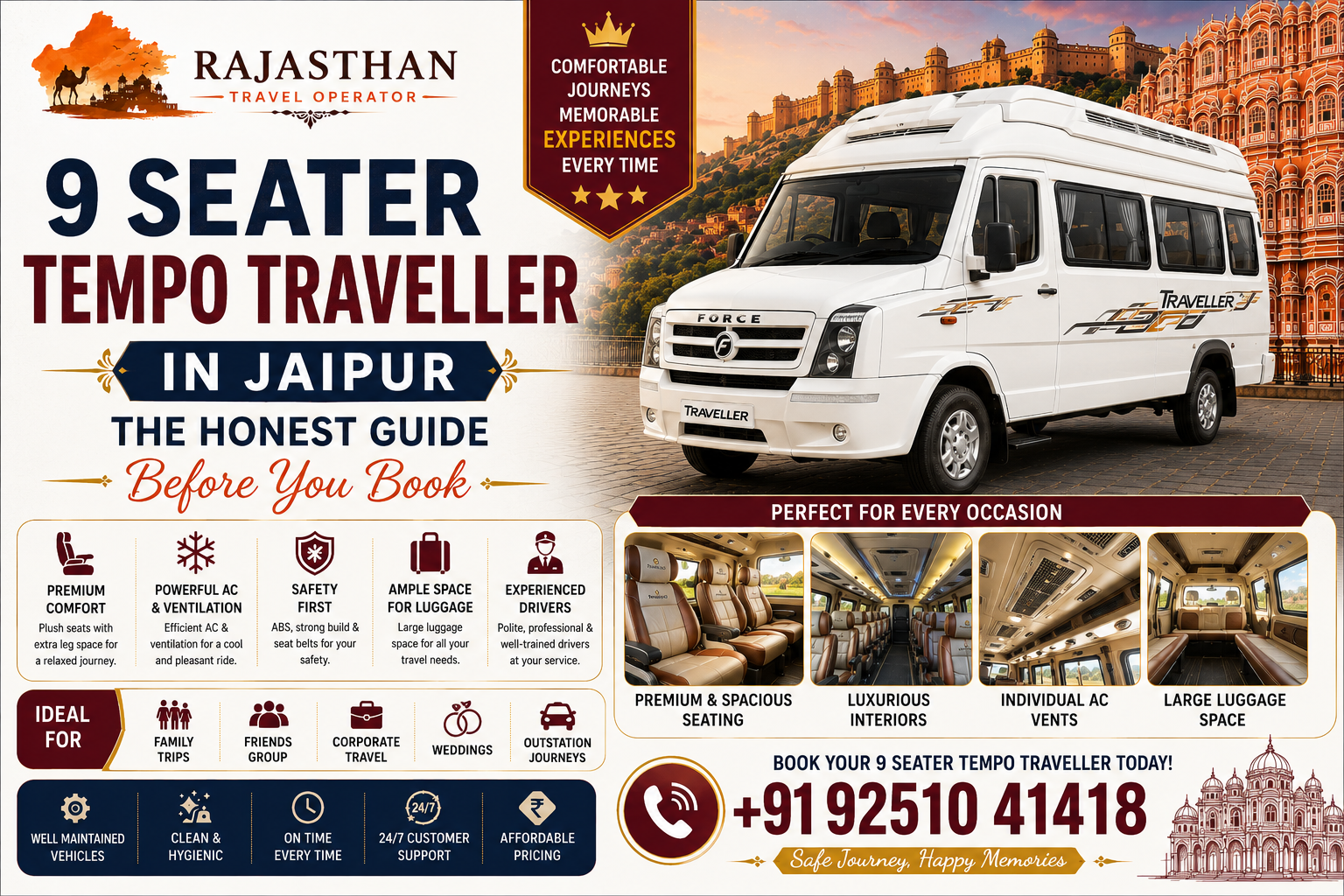
Nine is the number that shows up for a group that’s just past what a car can handle comfortably, but nowhere near needing a full-size van. Two SUVs would mean two drivers, two routes, and someone always arriving five minutes after everyone else. A 9 seater tempo traveller solves that cleanly — one vehicle, one driver, everyone together, and none of the overhead of booking a bigger van you don’t need.
It’s the entry point of the tempo traveller range in Jaipur, and it’s often the size people skip past without checking, assuming a 10 or 12 seater is the “real” starting point. For a group that’s genuinely seven to nine people, that assumption costs money for no real benefit — the smaller body does the same job at a lower daily rate, with no meaningful comfort penalty for a group this size.
The Seat Math at Nine
Nine seats plus the driver, on the smallest standard body in the tempo traveller lineup. Because the seat count is modest relative to the vehicle’s length, spacing tends to be genuinely comfortable — this isn’t a squeezed-down version of a bigger van, it’s a body sized appropriately for the headcount it’s built to carry.
Luggage works the same way it does across the rest of the tempo traveller range: it’s a ladder-frame chassis, so a roof carrier is standard equipment, not an upgrade. Big suitcases go up top, the boot behind the last row stays free for day bags, and the aisle stays walkable. Nine adults with nine full multi-day bags is a completely normal booking here, as long as the roof carrier is confirmed and fitted before pickup.
Count like this: seven to nine adults with luggage, comfortable — this is the size’s natural range. Ten or eleven confirmed, don’t add extra people into the same nine seats, move up to the 10 seater tempo traveller instead, which is often the same body class with a bit more room built in. And if it’s genuinely five or six people, a 9 seater is still worth checking against smaller options — but for most groups in this range, it remains the more practical single-vehicle choice over splitting into two cars.
Where the 9 Seater Sits in the Fleet
It’s the value entry point — the smallest vehicle where a group still travels as one unit with a dedicated driver, at the lowest daily rate in the tempo traveller range. Everything above it in the fleet costs more not because it’s a fundamentally different vehicle, but because it’s carrying more people or more premium trim.
Trim follows the same pattern here as everywhere else in the range. A basic 9 seater has pushback seats and a dashboard blower — fine for a short day trip, less ideal for a long highway stretch in peak summer. A luxury tempo traveller trim adds roof-mounted AC, better seat padding, curtains, and a working sound system, worth the difference the moment your trip crosses two or three hours. Some fleets also offer this exact seat count in a wider individual-chair layout — see the Maharaja seat tempo traveller page for how that configuration works and where it’s available.
For groups that want the smoothest possible ride over practicality, the smallest Urbania tempo traveller size — paired with premium seating in the 9 seater Urbania with Maharaja seats — is the step-up alternative. It rides better on the highway but gives up the roof carrier entirely, so every bag travels inside the cabin. That trade-off is worth knowing about even if you ultimately stick with the standard 9 seater.
Who Should Book It — and Who Shouldn’t
Book it for a small family group of seven to nine doing a Rajasthan circuit — Jaipur–Jodhpur, Jaipur–Pushkar, or a relaxed multi-day loop where the group wants to stay together without paying for a bigger vehicle.
Book it for a small temple or pilgrimage group. Khatu Shyam Ji, Salasar, Nathdwara, Ajmer Sharif — a manageable group size, early starts, frequent stops.
Book it for a small corporate booking — airport pickups, a compact site visit team, guest movement for a small event — where reliability and cost efficiency both matter.
Think twice if the headcount could grow. “About nine, might be ten or eleven” isn’t a nine-seater booking — confirm the list first, or book the size your worst case actually needs.
Think twice if the trip is very short and local with a very small group — three or four people for a half-day city tour might be better served by a cab, since the tempo traveller’s advantage shows up most on longer, multi-stop trips.
Skip it if the real number is closer to twelve or more — that’s a job for the tempo traveller 12 seater or 12 seater hire in Jaipur, and stretching a 9 seater to fit extra people defeats the comfort advantage that makes this size worth booking in the first place.
The Routes Where It Earns Its Keep
Jaipur–Jodhpur and Jaipur–Pushkar. Comfortable multi-hour highway runs where a small, well-spaced group travels easily without paying for extra seats they don’t need.
Ranthambore weekends. Two to three hours each way, a compact family or friend group, one overnight — a very natural fit for this size.
Khatu Shyam Ji and Salasar darshan. Straightforward roads, a manageable group, restful rather than cramped.
Short Golden Triangle add-ons. For a small group doing Jaipur and Agra without the full three-city loop, a 9 seater covers the distance comfortably without the cost of a bigger vehicle.
Before You Book — Five Things in Writing
Confirm the exact model and body. Ask which vehicle is being quoted as the 9 seater, since fleets vary in exactly how this size is built out.
Confirm the AC type and RC year. Roof-mounted AC versus a dashboard blower matters even at this smaller size, especially on longer routes. Ask for the registration year as a plain number.
Confirm the roof carrier, out loud. Standard on this body, but say your bag count and get it confirmed as fitted for your specific dates.
Kilometre cap and the beyond-cap rate. Usually 250–300 km a day. Multi-city trips can cross this even with a smaller group, so get the per-km overage figure upfront.
One all-inclusive number on WhatsApp. Tolls, permits, parking, driver food and stay, night charges — all folded into a single figure before you commit.
Frequently Asked Questions
How many people actually fit in a 9 seater tempo traveller? Nine passengers plus the driver, with comfortable spacing since the body is sized appropriately for this headcount rather than a stretched-down bigger vehicle.
Is a 9 seater much cheaper than a 10 or 12 seater? Somewhat, yes — it’s the entry point of the range, and for a group that genuinely fits within nine, it’s the most cost-efficient way to travel as one unit rather than paying for unused seats on a bigger vehicle.
Does it have a roof carrier? Yes — standard on this ladder-frame chassis, same as the rest of the tempo traveller range. Confirm it’s fitted for your specific booking.
Should I book a 9 seater tempo traveller or the Urbania version? Tempo traveller if luggage and budget matter more, since the roof carrier stays available. The Urbania version if ride comfort on long highway stretches is the priority and the group can manage with luggage inside the cabin.
How early should I book a 9 seater in Jaipur? Four to five days ahead in normal season. Around wedding muhurats, Diwali, the Pushkar fair window, and long weekends, book seven to ten days out — the better-maintained vehicles across every size get committed first.
Final Word
The 9 seater doesn’t get much attention in most fleet listings, but for a group that’s genuinely seven to nine people, it’s the most efficient booking in the entire range — full comfort, one vehicle, one driver, without paying for seats that would sit empty on a bigger van. Full comparisons across the whole size range are on the tempo traveller on rent page if you want to double-check where your group actually lands before booking.
Count your people honestly, confirm the model and roof carrier in writing, and get one all-inclusive number before you commit. That’s the whole process, and at this size, it rarely goes wrong once those basics are locked in.