What the 9 Seater Urbania Maharaja Seat Actually Is
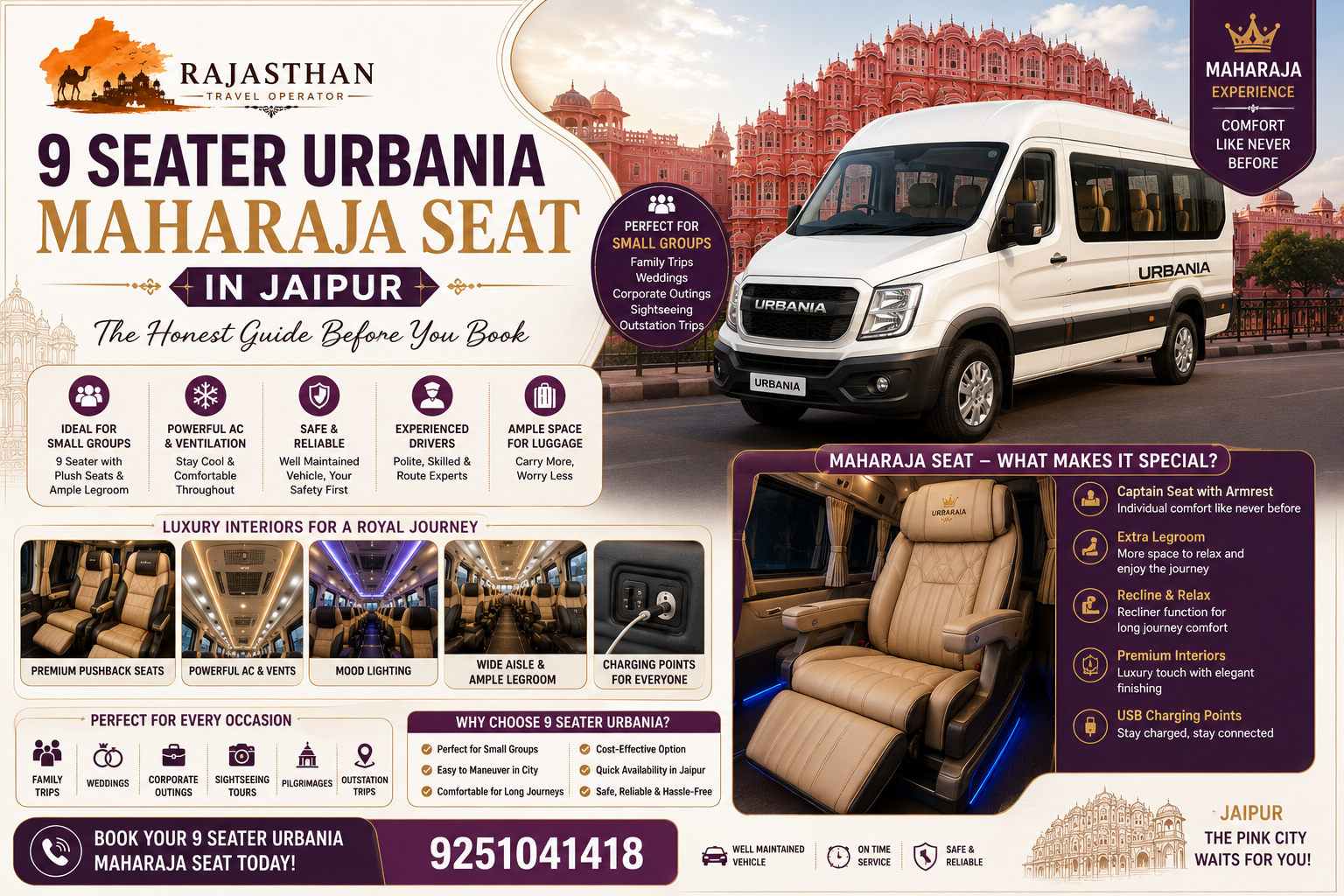
Two upgrades stacked on one vehicle — that’s the whole product. The Urbania body fixes the riding: monocoque construction instead of a ladder frame, a cabin you walk through standing up, an engine you talk over instead of shout over, suspension built for ride quality rather than bolted on afterwards. The Maharaja seats fix the sitting: individual captain-style chairs, wide base, deep recline, armrests on both sides, nobody negotiating a shared seat edge for six hours.
Most vehicles in the Jaipur fleet give you one or the other. A Maharaja seat tempo traveller puts great chairs on a standard platform. A plain Urbania tempo traveller puts a great platform under ordinary seats. The 9 Seater Urbania Maharaja Seat is the only configuration where both problems are solved at once — which is why it sits at the top of the small-group market out of Jaipur right now.
The Seat Math — Stricter Here Than Anywhere Else
Nine is the badge number, not the boarding number. Maharaja chairs are wide — that’s the point of them — and wide chairs eat cabin space. Add multi-day luggage and the honest capacity is seven adults travelling in genuine comfort, eight if the bags are light. For a city day, nine fits. For the Jaisalmer highway, plan for seven and thank yourself at the first fuel stop.
If your headcount is already at nine with real luggage, don’t squeeze into the premium vehicle and cancel out the premium. A 12 Seater Urbania gives the same cabin quality with breathing room, and the extra cost is smaller than people assume — driver, permits and tolls stay fixed, only fuel moves. One size up always beats one size tight, and that rule matters more when you’re paying luxury rates.
Where Your Money Goes — The Full Ladder
Bottom rung: the standard 9 Seater Tempo Traveller. Pushback seats, AC, honest workhorse. For a Jaipur city circuit or a one-day darshan, it does the same job this vehicle does at a fraction of the rate — and no honest operator will tell you otherwise.
Middle rungs: the Maharaja seat swap fixes long sitting; a general luxury tempo traveller upgrades the cabin and interiors without the full Urbania platform. Below roughly four hours of daily driving, one of these middle steps is usually all anyone actually notices.
Top rung: the luxury Urbania tempo traveller in Jaipur with Maharaja seating — this vehicle. You’re paying for the compounding effect: the platform removes the road, the chairs remove the fatigue. On a 400 km day the difference isn’t comfort, it’s condition on arrival. Elderly parents step out of this vehicle ready for dinner. Out of a standard body, they step out ready for bed.
Who Should Book It — and Who’s Overpaying
Book it if: the route is long-haul — Jaipur–Udaipur, Jaipur–Jaisalmer, the full Golden Triangle — and the passenger list includes parents, in-laws, or anyone for whom the journey is part of the gift. Small wedding-family groups, NRI relatives on a once-in-years Rajasthan trip, corporate movements where the vehicle is part of the impression. Six to seven people, comfort-first, distance-heavy: this is the answer.
You’re overpaying if: the plan is Amber–Hawa Mahal–Jal Mahal and back by dinner. City circuits never let the Urbania platform show what it does; a standard 10 seater tempo traveller does that day identically and the savings buy the group a very good meal. Same for a single-day Khatu Shyam Ji run on decent roads — the premium is real money for a difference nobody will feel.
And if the group is simply bigger: stop compressing. A 16 seater Urbania carries a full extended family with the same cabin quality, or a tempo traveller 12 seater covers the middle ground on a standard platform. The economics repeat at every size: fixed costs stay fixed, only fuel scales.
The Routes Where This Vehicle Earns Every Rupee
Jaipur–Udaipur. Around 400 km, and the stretch after Chittorgarh is where standard bodies start transmitting the highway into spines. This is the single route most responsible for Urbania Maharaja bookings out of Jaipur.
Jaipur–Jaisalmer. The longest common haul in the market — 550+ km. In a standard vehicle this is an endurance event. In this one it’s a long, comfortable morning and afternoon.
Golden Triangle with parents. Jaipur–Agra–Delhi, multiple highway days back to back. Cumulative fatigue is the enemy on multi-day circuits, and this configuration is the only one in the small-group fleet that resets it overnight.
Multi-day Rajasthan circuits. Jodhpur, Ranthambore, Pushkar strung together over four to six days. The daily kilometres are moderate; the repetition is what the Maharaja chairs neutralise.
For anything shorter, be honest with yourself and browse the general tempo traveller on rent options first — the right vehicle for the route beats the best vehicle in the fleet.
Before You Book — Five Things in Writing
Photos of the actual assigned vehicle — cabin, chairs, luggage bay. In this segment especially, “Urbania Maharaja” gets used loosely for retrofitted standard bodies. The photo settles it.
RC year. The Urbania is a recent platform, so the fleet skews new — but ask anyway. A 2022 Urbania and a 2025 Urbania are different rides.
The kilometre cap and the beyond-cap rate. Usually 250–300 km a day; long Rajasthan routes blow past it. Know the per-km number before the trip, not at settlement.
One all-inclusive figure on WhatsApp — tolls, state permits, parking, driver food and stay. At luxury rates, the gap between “quote” and “final bill” is where operators quietly recover their discount.
Whether this driver has done this route in this vehicle. The Urbania is taller and longer than a standard TT; hotel porches and fort parking that swallow an Innova don’t always take it. Route experience in this body is the question.
Frequently Asked Questions
How many people travel comfortably in a 9 Seater Urbania Maharaja Seat? Seven adults with multi-day luggage. Eight with light bags. Nine only for short city runs.
What does it cost per day in Jaipur? No honest fixed number — pricing moves on kilometres more than days, and this vehicle’s premium widens on longer routes. Send your exact route and dates, ask for one all-inclusive figure.
Is it worth it over a standard Maharaja seat vehicle? Above four hours of daily driving, or with elderly passengers — yes, and visibly so by the first evening. Below that, the standard Maharaja option keeps most of the comfort at a friendlier rate.
Is a driver included? Always. Self-drive isn’t a real market for this category in Rajasthan. Confirm the driver allowance sits inside your all-inclusive quote.
How far ahead should I book? Further than anything else in the fleet. October to February, a week minimum — these vehicles are few, and wedding muhurats and long weekends take them first. For a fixed-date family trip, two weeks is the safe answer.
Final Word
The 9 Seater Urbania Maharaja Seat is not the sensible default — the standard 9 seater owns that title and always will. This is the vehicle for the trips where the journey itself matters: long highways, comfort-first passengers, occasions worth arriving fresh for. Match it honestly to your route. If the answer is a city day, save the money. If the answer is Udaipur with your parents in the back — book it early, get one all-inclusive number on WhatsApp, see the actual vehicle’s photos, and let the road do its worst.