Why Five Short Scenarios Instead of One Long Guide
Every group renting a tempo traveller in Jaipur thinks their situation is fairly unique, and in a narrow sense it is — but most bookings fall into a handful of recognisable patterns once you look across enough of them. Rather than another general fleet overview, here are five distinct, realistic scenarios, the questions each one actually needed answered, and what each group ended up booking and why.
Scenario 1: The Uncertain Headcount
A family started planning a Rajasthan trip with “around ten or twelve people” and kept going back and forth on the exact number for weeks as relatives confirmed or dropped out. They almost booked a tempo traveller 12 seater early, purely to “be safe,” before the final list settled at nine confirmed.
What actually solved it: waiting for the confirmed list before booking, rather than locking in a size based on the highest possible number. They ended up with the 9 seater tempo traveller instead, saving a meaningful amount over the larger vehicle they’d almost booked out of anxiety about the group shrinking. The lesson: an uncertain headcount is a reason to delay booking a few extra days, not a reason to overbook a bigger size “just in case.”
Scenario 2: The Multi-City Trip With Genuinely Heavy Luggage
A group of fifteen planning a week-long circuit — Jaipur, Jodhpur, Jaisalmer, Udaipur — with a family wedding function partway through, meaning formal clothes and gift items on top of the usual multi-day luggage. They initially considered the 16 seater Urbania for the smoother highway ride, since several long driving days were on the itinerary.
What actually solved it: running the numbers on luggage honestly. Fifteen people with a week’s worth of bags plus wedding items simply wasn’t going to fit comfortably inside a cabin with no roof storage, whatever the ride quality benefits. They switched to the tempo traveller 17 seater with a properly fitted roof carrier, prioritising luggage flexibility over ride smoothness once the actual bag count was laid out. The lesson: ride comfort matters, but a genuinely heavy-luggage, multi-city trip usually settles the chassis question before comfort even enters the conversation.
Scenario 3: The Comfort-First Small Group
Two couples in their sixties, longtime friends, planning a relaxed week seeing Rajasthan together with light luggage and no particular budget constraints. Their priority from the start was comfort over cost — they specifically didn’t want to be packed into tight rows on long highway days.
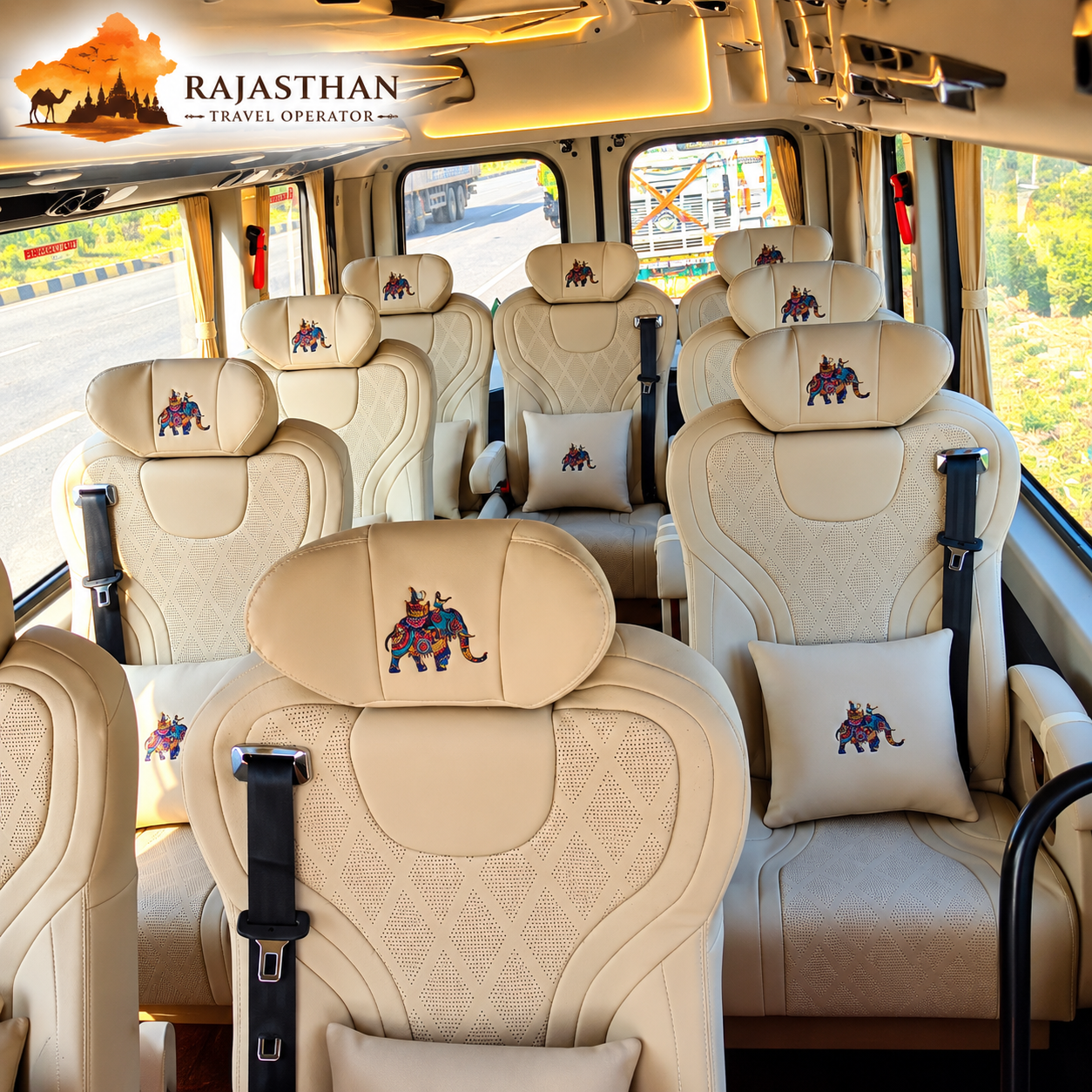
What actually solved it: the 12 seater Urbania, booked with room to spare rather than filled to capacity, giving all four passengers genuinely generous space for the whole trip. Because their luggage was light and their group was small relative to the seat count, the platform’s usual luggage trade-off never became a real constraint. Some in the group also asked about the 9 seater Urbania with Maharaja seats configuration for even wider individual seating, though ultimately decided the standard 12 seater Urbania layout gave enough room without the extra cost. The lesson: a small group with light luggage is exactly the scenario where the Urbania platform’s trade-offs disappear almost entirely.
Scenario 4: The Large Wedding Guest Movement
A wedding family needed to move twenty-two out-of-town guests from the Jaipur airport to their hotel, then to the wedding venue the following evening, then back to the airport two days later — three separate trips across a compressed schedule with a genuinely large guest count.
What actually solved it: splitting into a 20 seater tempo traveller for the bulk of the group plus a smaller tempo traveller 12 seater for the overflow and any staggered arrival times, rather than trying to force twenty-two people into a single vehicle or running an awkward number of trips with one large vehicle. They also specifically asked about Maharaja seat tempo traveller configurations for the elder relatives in the group, arranging a few upgraded seats within the larger vehicle rather than a separate booking. The lesson: large event bookings often need a combination of vehicle sizes rather than one perfect single answer, and it’s worth pricing combinations before assuming one big vehicle is automatically the simplest solution.
Scenario 5: The Elderly-Focused Pilgrimage Group
A group of eight, mostly grandparents and their adult children, planning a temple circuit — Khatu Shyam Ji, Salasar, Nathdwara — with real concerns about comfort given the older passengers’ mobility and stamina for a multi-day trip with several stops.
What actually solved it: a Maharaja seat tempo traveller configuration on a standard chassis, specifically chosen over both a plain standard vehicle and the Urbania platform. The wider individual seating addressed the elderly passengers’ comfort directly, while keeping the standard chassis meant the roof carrier stayed available for the group’s luggage — including blankets, prasad, and the various small items a pilgrimage trip tends to accumulate. They’d also considered a luxury tempo traveller upgrade without the Maharaja configuration, but ultimately felt the wider seating mattered more for this specific group than trim alone would have delivered. The lesson: for groups with specific comfort needs tied to age or mobility, the seating configuration decision often matters more than trim level or even chassis type.
What These Five Scenarios Have in Common
Across all five, the actual booking decision rarely came down to a single feature or spec. It came down to identifying which one or two factors mattered most for that specific group — a confirmed headcount, real luggage volume, comfort priorities, event logistics, or passenger-specific needs — and letting that factor drive the choice, rather than defaulting to whichever size or trim sounded most impressive on a listing.
This is also why a genuinely useful conversation with an operator rarely starts with “what’s your best vehicle” and instead starts with the specifics of the actual trip — how many people, confirmed or not, how much luggage, how long the driving days are, and whether anyone in the group has particular comfort needs. The vehicle choice tends to follow naturally once those details are actually on the table.
A Quick Way to Place Your Own Trip
Ask which of these five scenarios your own situation most resembles. An uncertain headcount points toward waiting for confirmation before booking, the way Scenario 1’s family eventually did. Heavy multi-city luggage points toward a standard chassis with a roof carrier, as Scenario 2 settled on. A small, light-luggage group prioritising comfort points toward the Urbania platform, as Scenario 3 found. A large event with multiple pickup points and a tight schedule often needs a combination of vehicle sizes, as Scenario 4’s wedding family worked out. And a group with specific comfort needs tied to age or mobility often benefits most from a seating configuration change rather than just a trim upgrade, as Scenario 5 discovered.
If your trip is some combination of these, or doesn’t quite match any of them, full comparisons across the whole fleet — every seat count from the 10 seater tempo traveller upward, both chassis types, and every trim level — are worth reviewing on the tempo traveller on rent page before reaching out to any operator.
Frequently Asked Questions
How do I know which scenario my own trip is closest to? Identify your single biggest constraint first — headcount uncertainty, luggage volume, comfort priorities, event logistics, or passenger-specific needs — and that constraint usually points clearly toward one of these five patterns.
What if my trip has more than one of these factors at once? Common, and worth discussing directly with the operator rather than trying to solve it yourself — most experienced operators have seen combinations like this before and can suggest a practical solution, as Scenario 4’s wedding family found with their combined vehicle approach.
Is it normal to change plans partway through the booking conversation, like Scenario 1 or Scenario 2 did? Yes, and it’s usually a sign of good planning rather than indecision — both groups ended up with a better-fitting, sometimes cheaper, option specifically because they didn’t lock in a decision before the real constraints were clear.
Do operators expect this level of detail before quoting? A good one welcomes it — the more specific your situation, the more accurate and useful the first quote will be, rather than a generic figure that needs several rounds of adjustment later.
Which of these five scenarios is the most common booking type in Jaipur? Scenario 1 and Scenario 2’s general pattern — a family or friend group with a confirmed or near-confirmed headcount planning a multi-day circuit — covers the largest share of bookings, though every scenario here shows up regularly across the season.
Final Word
These five scenarios aren’t meant to be a perfect match for every trip, but they illustrate something more useful than another spec comparison: the right booking decision almost always comes from identifying your trip’s one or two biggest real constraints, not from picking the most feature-rich vehicle available. Place your own trip against the pattern that fits closest, and the rest of the booking conversation usually becomes much more straightforward.